Australia win FIFA Series after beating spirited home side

Kenya 0-2 Australia

By Alyce Collett 15/4/26

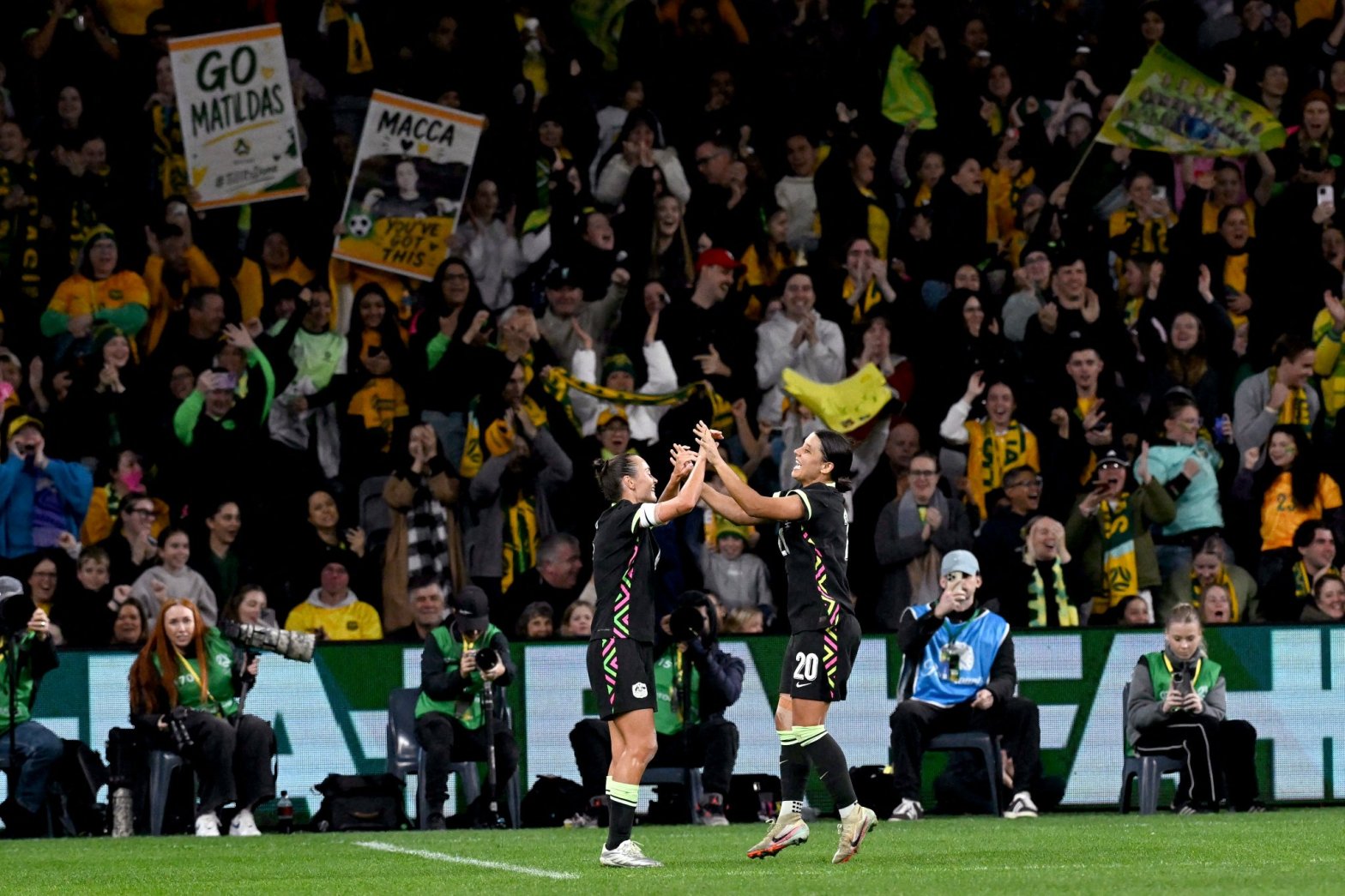
Above: Hayley Raso (left) and Sam Kerr (right) celebrate after the latter scored the opening goal in Australia’s win over Kenya tonight. Photo: via Commbank Matildas.

Australia has won its 2026 FIFA Series after defeating Kenya 2-0 in today’s final.

It was not a pretty performance from the Matildas, with the side not delivering its finest performance, but goals from Sam Kerr and Clare Wheeler ultimately saw the series favourites get the job done.

Unsurprisingly it was the Australians who initially took a leading role in setting the tone for the match, with Hayley Raso in particular looking lively early.

However though despite what their world ranking would suggest, the Kenyans did really take it up to the Matildas for much of the first half.

The first half was much more competitive than any stage of the match against Malawi on the weekend was, and although they were getting good runs down both wings Kenya just did not have the numbers in the box to truly capitalise.

Vivian Nasaka was being lively for Kenya, but was playing a very wide left wing role and as such did not have the support in the box from her team mates to maximise on how close she was getting to goal. Tereza Obunyu was also getting some good runs through the middle, but much like Nasaka did not have the numbers support to truly capitalise.

It may have taken almost 25 minutes, but eventually the Matildas did finally find the opening goal through Kerr, whose shot initially was stopped by the Kenyan keeper Lilian Onyango, but the ball then slipped through her hands and the ball trickled into the back of the net.

One thing the first half was teaching Australia was to be really patient with their shots on goal, really having to wait to find the space and then shoot, despite having more of the ball in more dangerous positions in front of goal than its opposition.

Kenya did have some really strong shots on goal through Shalyne Opisa and Fasila Omondi, but some strong goal keeping from Mackenzie Arnold denied the Kenyans an equaliser thrice within a minute.

Kerr’s goal proved to ultimately be the only one of the first half, and the Australians went into the half time break with plenty to think about ahead of the second half.

Australian coach Joe Montemurro did make an intriguing substitution at half time, with midfielder Emily van Egmond coming on in place of winger Raso and Amy Sayer pushing into that wider role Raso had been playing.

Australia started on the front foot in the second half, with Kerr and Caitlin Foord working well together to generate shots on goal for Australia, albeit their shots ultimately kept going slightly wide of the target.

The Matildas did finally find a second goal about 10 minutes into the second half after Wheeler found herself with the ball at the top of the box, and danced her way around several defenders before striking the ball perfectly into the back of the net.

Australia almost had a third about five minutes later via Foord, but the goal was ruled invalid.

Kenya certainly kept pushing the Matildas, particularly the likes of Opisa giving the Aussie defence plenty to think about, but just lacked the quality of finishes to make the most of any chances.

One thing that will concern Montemurro and his staff moving forward was the lack of clinical passing, with the passing particularly in transition leaving much to be desired and handing the Kenyans much easier opportunities to intercept than a side of Australia’s quality should have been.

Ultimately those two goals were enough for the Australians to get the job done, but the Australian coaching staff will leave Kenya with plenty to think about ahead of the next stage of the team’s preparations for next year’s World Cup.

Teams: KENYA (4-3-3): Onyango, Jereko, Nasaka, Opisa, Emedot, Obunyu, Norah, Ochaka, Andiema, Madalina, Omondi. Substitutes: Kundu, Lwangau, Okumu, Nyabuto, Serenge, Muange, Vidah, Mukhwana, Airo, Shilwatso, Mango.

Goals:

AUSTRALIA (4-3-3): Arnold, Torpey, Rule, Heatley, Rankin, Wheeler, Sayer, Kennedy, Raso, Foord, Kerr. Substitutes: Chidiac, Nevin, Nash, Gomez, Lincoln, Aquino, Van Egmond, McKenna, McNamara, Siemsen.

Goals: Kerr 20’, Wheeler 55’

Referee: Yordanos Mulugeta (Ethiopia)

Attendance: TBC.

Follow Impetus on social media: 

@ImpetusFootball on Threads, Instagram and TikTok.

England hold strong to see out win over Spain

England 1-0 Spain

By Damion Arnold 14/4/26

Above: Lauren Hemp celebrating her goal in the opening three minutes. Photo: via Lionesses

After scoring early on, England held defensively strong to keep Spain out and secure all three points in their race to World Cup qualification.

The two-time European Champions took the lead early through Hemp. In the third minute, Greenwood’s corner ball was not cleared well with the ball bouncing around the six-yard box. Hemp struck the ball on the volley and after some confusion as to whether the ball crossed the line, the goal line technology signaled it had.

Hemp had the chance to double the lead in the 19th minute, but her effort struck the post.

Ona Battle found herself with an unusual opportunity inside the England box. After receiving the ball and weaving between three England bodies, she takes a close-range shot. However, the full-back slices the shot and her effort flies over the bar.

Just before the break, the visitors registered their first shot on target. Patri Guijarro slipped behind the England defense and directed the crossed ball goalward. Hannah Hampton was there to stop the shot at her front post.

Five minutes into the second half, the visitors hit the bar. Olga Carmona stuck the crossbar inside the England penalty box.

On her senior debut, Lucia Kendall squandered a golden opportunity to score a goal just a minute after the Spain chance. Alessia Russo unselfishly slotted the ball across goal for Kendall, but the 21-year-old blazed the ball over.

Vicky Lopez missed a great chance to level the game in the 56th minute. She receives the ball inside the England box and strikes the ball well. Unfortunately, the effort struck the post and bounced out.

12 minutes later, Lopez found herself in another shooting opportunity. After cutting in from the right, she watched her effort get parried away by Hampton.

In the 70th minute, Claudia Pina’s corner found fellow Barcelona teammate Irene Parades at the back post. The centre-back could not direct the headed effort on target.

Hampton produced an excellent save in the 90th minute, denying Edna Imade’s close range-headed effort.

Lineups: England (4-3-3): Hampton (Chelsea), Bronze (Chelsea), Wubben-May (Arsenal), Morgan (Washington Spirit), Greenwood (Manchester City), Kendall (Aston Villa), Walsh (Chelsea), Stanway (Bayern Munchen), Hemp (Manchester City), Russo (Arsenal), James (Chelsea). SUBS: Moorhouse (Orlando Pride), Roebuck (Aston Villa), Carter (Gotham FC), Le Tissier (Manchester United), Charles (Chelsea), Hinds (Arsenal), Parkinson (Valadares Gaia), Blindkilde (Arsenal), Kelly (Arsenal), Park (Manchester United), Barry (Bay FC)

Goal scorers: Hemp 3’.

Yellow cards: Bronze 85’ , Hampton 90+4’


Spain (4-3-3): Coll (Barcelona), Batlle (Barcelona), Parades (Barcelona), Leon (Barcelona), Carmona (Paris Saint Germain), Caldentey (Arsenal), Guijarro (Barcelona), Putellas (Barcelona), Lopez (Barcelona), Gonzalez (Gotham FC), Pina (Barcelona). SUBS: Nanclares (Athletic Club), Misa (Real Madrid), Navarro (Real Madrid), Fernandez (London City Lionesses), Codina (Arsenal), Corrales (London City Lionesses), Mendez (Real Madrid), Serrajordi (Barcelona), Benitez (Athletico Madrid), Athenea (Real Madrid), Imade (Bayern Munchen), Paralluelo (Barcelona).

Goal scorers: N/A

Yellow cards: Parades 59’.


Referee: Tess Olofsson

Attendance: 62,308.

Follow Impetus on social media: 

@ImpetusFootball on Threads, Instagram and TikTok.

Girls in Green secure huge prize with hard fought win

Poland 2-3 Republic of Ireland

By Alyce Collett 14/4/26

Above: Aoife Mannion (left) and Katie McCabe (right) celebrate after McCabe scored a trademark banger of a goal early in Ireland’s confidence boosting win over Poland. Photo: via Ireland Football.

The Republic of Ireland has breathed some new life into its World Cup qualifying campaign, earning a hard fought 3-2 win over Poland.

The Irish did control proceedings for much of the match and skipped out to an early lead thanks to Emily Murphy and skipper Katie McCabe, before a timely goal from Tanja Pawollek just changed the script a bit for the home side. Goals to Marissa Sheva and Ewa Pajor in the second half ultimately ensured that half time margin was also the full time margin.

The way that the Irish were able to win the match will also give them a lot of confidence not only for the return leg of this window on the weekend, but moving forward into the final window of the campaign. Despite losing momentum towards the end of the first half, the Irish regrouped well at half time and defended really well to ultimately emerge victorious.

Initially it was a pretty even start to the match, with neither side really taking control of proceedings.

One thing that both sides were doing early though was misplacing their passes, with the poor quality of the pitch not helping either side’s passing accuracy.

Eventually the Irish did make the break through on the scoreboard 12 minutes in, when Murphy wrong footed a couple of defenders and curled the ball perfectly into the back of the net.

The goal really gave the Irish a positive spring in their step, and as such they were starting to take a little bit of control of the match and a strong counter press from the Girls in Green was helping box the Poles into their defensive third.

That pressure brought reward again in the 20th minute, when the deflection of a corner cross found McCabe at the edge of the box, who then scored an absolute banger from distance to double the Republic of Ireland’s lead.

Poland did have a really strong chance just before the half an hour mark, but some strong defensive work at the death from Aoife Mannion and then Anna Patten denied Natalia Padilla-Bidas and then Pajor.

But despite the brief moments of positivity from Poland as the half progressed, it was the visitors who were in control of the match. Paulina Tomasiak was proving dangerous on the left wing for Poland, but closer to goal some attentive defending from the Irish meant that the danger was reduced.

Just as it was looking like the Irish were going to take a clean sheet into the half time break, Pawollek popped up and headed the cross in perfectly to get one back for the home side.

Pawollek’s goal changed the balance of the game at the half time break.

The Poles gaining some confidence after being on the back foot for much of the half while for the visitors it was a case of needing to reset and take control of the match back to avoid proceedings ending the same way both matches did last window.

The second half started in much the same even way the first did, with both sides getting promising looks on goal.

Poland did deploy a slight change in tactic early in the second half though, with long through balls to the Polish attackers becoming a more prevalent part of proceedings.

It was the Republic of Ireland who would score first in the second half though, when Sheva used her powerful shooting ability to strike a long range shot from just inside the box straight into the back of the net.

Sheva’s goal seemed to settle things for the Irish, who really did retake control of the match and were passing with a lot more confidence than the home side were.

Poland were not going down without a fight though, and after her influence had been curtailed for most of the match, Pajor popped up with just over 10 minutes to go and perfectly chipped a shot over Courtney Brosnan and into the back of the net to breathe some life into the game for the hosts.

The Irish had a prime opportunity to put a halt to that breath of life mere minutes later, but McCabe uncharacteristically missed a penalty shot on goal.

It ultimately did not matter because as hard as Poland pushed at the end of the match, the Irish held firm and earned the full three points.

Teams: POLAND (4-3-3): Szemik, Zaremba, Woś, Dudek, Wiankowska, Achcińska, Kamczyk, Pawollek, Tomasiak, Pajor, Padilla-Bidas. Substitutes: Radkiewicz, Szperkowska, Araśniewicz, Cyraniak, Grzybowska, Jedlińska, Kokosz, Nowak, Sarapata, Szymaszek, Zawistowska, Zieniewicz.

Scorers: Pawollek 43’, Pajor 78′

REPUBLIC OF IRELAND (5-3-2): Brosnan, Mustaki, Hayes, Mannion, Connolly, O’Sullivan, McCabe, Patten, Sheva, Larkin, Murphy. Substitutes: Moloney, Whitehouse, Reynolds, Kiernan, Ziu, Barrett, Clancy, Quinn, Finn, Noonan, Toland.

Scorers: Murphy 12’, McCabe 20’, Sheva 59′

Referee: Hristiyana Guteva [BUL]

Attendance: TBC.

Follow Impetus on social media: 

@ImpetusFootball on Threads, Instagram and TikTok.

Potentially course altering window ahead for the Girls in Green

by Alyce Collett (14/4/26)

Above: Will Katie McCabe (facing camera) and her Irish team mates have anything to truly celebrating in this potentially course altering international window? Photo: via @IrelandFootball on Twitter.

Republic of Ireland vs Poland– April 2026

Tuesday 14th April
5pm kick off local time
Polsat Plus Arena, Gdańsk

Saturday 18th April
4pm kick off local time
Aviva Stadium, Dublin

Both matches will be streamed on RTÉ2 and the RTÉ Player, but those outside the island of Ireland will need a strong VPN to access the RTÉ coverage.

It is the dawn of another international window, and like all their international windows these days, this one is a significant one for the Republic of Ireland.

In the middle of the another Nations League campaign – this one serving as qualifiers for next year’s World Cup – this window in particular is perhaps more make or break than usual for the Girls in Green.

Last window saw some impressive performances from the Irish, which saw them really match it with two of the best teams in Europe – France and the Netherlands, but despite how noble those performances were they don’t count for much in the long run as they were both losses.

One trend with the Republic of Ireland in recent years is that when coming up against the stronger teams in the world, they will be competitive for much of the match and play better than their ranking in the mid to low 20s would suggest, but ultimately not able to get the job done on the scoreboard.

Although Poland should never be underestimated, these two matches provide the biggest opportunity for the Republic of Ireland to pick up some big points this campaign.

What happens this window could dictate a lot in terms of not only how easy the Irish path to qualifying for the World Cup is, but even more than that.

Finishing third in a League A group makes the play off path later this year much easier.

In the first round, whoever finishes third plays a team from League C, whereas the fourth placed side has to play a side from League B, a significant step up in quality. The side would still likely face a League B side in round two of the playoffs regardless, but the likelihood of making round two is significantly higher with that easier draw.

Not only all of this, but looking further ahead, if the Republic of Ireland finish third in their group, they remain in League A for the next Nations League campaign and break the cycle of rotating between being in League B one year, than League A the next.

For a side like the Republic of Ireland that is an up and coming side trying to lock down its place in the group of the top sides on the continent, more games against tough opponents is the only way this team will improve, and that’s just not available in League B.

Return of a legend equals massive boost
Above: Denise O’Sullivan will make a more than welcome return to the Irish side tonight after missing the second game of last international window.
Credit: via @IrelandFootball on Twitter

One thing that was really evident in the game against the Netherlands last window was the importance of midfield maestro Denise O’Sullivan to the heart of the Irish operation in midfield.

O’Sullivan missed the game against the Netherlands due to injury, and as such her ability to drive through the heart of midfield and break open a crowded pack was sorely missed by the Irish.

But O’Sullivan is back and ready to go this window, and after a strong run of form for club side Liverpool will be raring to go to help power the Republic of Ireland forward once again.

Will the boss reward club form?

One interesting area to keep an eye on will be how the Irish forward line sets up.

The Irish need to pick up their goal scoring production, but one trend manager Carla Ward seems to like to follow is that she has her favourite first choice players, and does not always reward domestic form with big minutes at international level.

Emily Murphy is in good form at club level and does get rewarded, but Saoirse Noonan, Abbie Larkin and Amber Barrett are also all in good form for their clubs but are not seeing the minutes for the national team that such form would suggest.

Will things change this window? Only time will tell.

Republic of Ireland Squad – April 2026 vs Poland

Goalkeepers: Courtney Brosnan, Sophie Whitehouse and Grace Moloney.

Defenders: Katie McCabe, Anna Patten, Caitlin Hayes, Aoife Mannion and Chloe Mustaki.

Midfielders: Denise O’Sullivan, Tyler Toland, Megan Connolly, Marissa Sheva, Lucy Quinn, Ruesha Littlejohn, Jess Ziu, Maria Reynolds, Aoibheann Clancy and Jamie Finn.

Forwards: Saoirse Noonan, Abbie Larkin, Leanne Kiernan, Emily Murphy, Kyra Carusa and Amber Barrett.

Follow Impetus on social media: 

@ImpetusFootball on Threads, Instagram and TikTok.

Reigning champs send Young Tillies packing

North Korea U20 3-0 Australia U20

by Alyce Collett (12/4/26)

Above: North Korea did plenty of celebrating in tonight’s win over Australia, showing why they are the reigning tournament champions. Photo: via AFC. 

Reigning Under 20 Women’s Asian Cup champions North Korea are through to the semi finals of the 2026 tournament after defeating Australia 3-0 tonight.

The North Koreans controlled proceedings for much of the match and found reward on the scoreboard through Pak Ok-I and Ro Un-Hyang as well as through a very unfortunate own goal from Young Matilda Rubi Sullivan. The Australians did play better than they had last time out against Japan, but had limited chances to attack and could not convert any of the chances they had.

North Korea did not take long to show its class, scoring after only three minutes.

Pak Ok-Iwas alone out the back of the box, and after the ball was perfectly crossed to her she was able to strike truly and give her side a very early lead.

The North Koreans dominated possession for much of the first half – ultimately having 68.5% of possession in the first half – leaving the Young Matildas to do a lot of chasing and not much dictating of the play.

The Australians did manage to get the ball into their attacking final third on a few occasions, but in the desperation to clear the congestion of North Korea’s midfield and attackers, Australia’s long balls were too long again and again, which were picked off by the North Korean defenders with relative ease.

Things got even harder for Australia about halfway through the first half when Danella Butrus went down in a collision and had to be substituted off.

Despite the immense defensive pressure and at times questionable tactics from their opponents, the Australians continued to play confidently and continued to fight hard.

Despite the continuous long, booting passes with a focus on distance over accuracy, Australia was a lot more defensively sure for most of the first half than it had been against Japan. It appeared that the Young Matildas had seemingly learnt the necessary lessons from both that game and the early goal in this one.

Australia had its first really dangerous opportunity about half an hour in when Tianna Fuller – who had come on for Butrus – fed the ball through near perfectly to Tahlia Younis, who unfortunately just could not quite squeeze around the North Korean defender and take a hold of the ball and shoot.

It was an at times chaotic first half, but in the end the half time scoreline was only 1-0 and things were starting to build positively for the Young Matildas.

The second half started in much the same way much of the first half played out, with Australia having to do a lot of defensive work.

The Australians did have another really strong chance to score early in the second half after an errant back pass from the North Koreans, but the Australian attackers unable to capitalise on the prime opportunity.

As the half progressed the energy and tension started to rise, with frustrations starting to boil at times from both sides.

As positive as Australia’s progression had been as the game progressed, disaster struck with about 15 minutes to go when a North Korean shot on goal deflected off the hip of Sullivan and into the back of the net.  

There was more heart ache for the Australians within the final moments of regular time when Ro Un-Hyang caught Illona Melegh well out of her box and was able to stroll the ball into an open net and score easily.

This was the icing on the cake for the North Koreans in what was a valiant but at times a frustrating day at the office for the Young Matildas.

Teams: NORTH KOREA U20’s (4-4-2): Pak Ju-Gyong, Jong Pok-Yong, Ri Ye-Gyong, Pak Ok-I, Choe Yon-A, Choe Rim-Jong, Kang Ryu-Mi, Ho Kyong, Pak Il-Sim, Ri Kuk-Hyang, Ro Un-Hyang. Substitutes: Kim Ju-Hyang, Jon Il-Chong, So Ryu-Gyong, Ri Su-Jong, Choe Chong-Gum, Yom Chol-Nim, Choe Kyong-Mi, An Kyong-Yong, Ri Ok, Ri Pom.

Scorers: Pak Ok-I 3′, Sullivan 74’ [OG]

AUSTRALIA U20’s (4-4-2): Melegh, Bennett, Bertolissio, Halmarick, McMahon, Kruger, Apostolakis, Prakash, Younis, Butrus, Sullivan. Substitutes:  Cassar, Dundas, O’Keeffe, Trimis, Fuller, Brown, Collins, Breier, Black, Henniker, Ritchie, Dale.

Referee: Gulshoda Saidqulova [Uzbekistan].

Attendance: TBC.

Follow Impetus on social media: 

@ImpetusFootball on Threads, Instagram and TikTok.

Building a Fanbase From Scratch: Who Supports London City Lionesses- and Why?

by Hope Robinson (11/04/26)

London City Lionesses have entered the Women’s Super League this season aiming to establish themselves among the division’s elite, competing against clubs with established fanbases and long-standing ties to men’s teams, while attempting to build a support base of their own from scratch.

What Makes London City Lionesses Different?

After gaining promotion at the end of last season, London City Lionesses have entered the Women’s Super League with clear intent. Survival has not been framed as the limit of their ambition, with the club targeting a place among the league’s top sides.

Recent seasons have seen a familiar pattern, with promoted teams often returning straight to the Championship. London City Lionesses have shown no sign of accepting that outcome.

They currently sit seventh in the table, level on points with Brighton & Hove Albion Women, holding their own in a competitive division.

Yet, the most interesting thing about the club is not their league position or ambition. London City Lionesses are the only side in the division not affiliated with a men’s team, raising a different question altogether. Who supports them?

Most women’s teams are tied to established men’s clubs with deep-rooted histories. Supporters often follow through existing loyalty, whether through family tradition or prior connection to the men’s side. For an independent club, attracting that same level of support presents a different challenge.

London City Lionesses are beginning to answer that challenge. Their recent fixture against Arsenal Women was sold out. The supporters are arriving, and so are the results.

Taking on the Giants

The scale of that challenge remains significant. Clubs such as Liverpool, Leicester City, Manchester United, and Aston Villa benefit from global fanbases, generational support, and regional identities.

London City Lionesses find themselves in a crowded region. As a London-based club, they share space with huge sides such as Arsenal, Chelsea, West Ham, and Tottenham Hotspur meaning location alone is not enough to separate them.

The National Women’s Soccer League offers a useful comparison. Clubs there operate independently, without direct links to men’s teams, but benefit from far larger geographical identities. In the United States, support is often tied to city or state rather than a shared club badge across men’s and women’s sides. Teams such as Angel City, Bay FC, and San Diego Wave represent expansive regions, allowing them to build distinct and natural followings even without the backing of a men’s counterpart.

That is not the case in London.

London City Lionesses are competing for attention rather than inheriting it. They are not only building a team, but also establishing relevance in a league where support can shape atmosphere and momentum.

Meet the LCL Fans

Without decades of history or a global brand behind them, the fanbase of London City Lionesses is unlike most sides in the women’s game. Their support is not inherited or passed down through generations. It is actively chosen.

The Women’s Super League has grown rapidly in recent years, with rising attendances and increased visibility introducing football to new audiences. Many of these supporters arrive without prior allegiances. For some, London City Lionesses have become a natural entry point into the women’s game.

The club’s fans are diverse. Local supporters are drawn by the accessibility of matches and the sense of community the club fosters. Younger audiences and families are increasingly present, attracted to matchday experiences that feel social and engaging. There are also football-first fans who follow the women’s game rather than a specific team, choosing London City Lionesses because of what the club represents as an independent side.

Others have not opted for larger clubs as, if not a football fan prior, it can appear overwhelming as to where to place your alliance, so a new, independent, and growing team can stand out.

What unites all these supporters is choice. They are not bound by family tradition, men’s club allegiances, or long-standing loyalty. They are fans who have actively decided to follow London City Lionesses, creating a relationship with the club that is built on engagement, shared experience, and community rather than history.

What They’re Getting Right

London City Lionesses are offering more than just what happens on the pitch, they are building a full matchday experience around it. Supporters who buy tickets with Mastercard have the chance to win meet-and-greet opportunities with players, something that helps create a closer connection between fans and the team. Around the game itself, there is a clear focus on atmosphere. 

Fan zones, live music, games and giveaways are regular features, alongside themed matchdays that feel more like events than just fixtures. Food options are varied too, with street food-style vendors adding to the overall feel of the day. Even after the final whistle, players often spend time with supporters, signing and interacting in a way that feels genuine. It is all quite simple, but it works. London City Lionesses are giving people a reason to come, and more importantly, a reason to return.

Building a fanbase from scratch requires more than performances on the pitch. It demands a reason for supporters to invest their time and attention.

Across the women’s game, growth has been clear. Arsenal Women have drawn crowds of over 40,000 for major fixtures, reflecting the rising interest in the sport. At the same time, that growth has highlighted a gap between the top end of the game and the everyday match-going experience.

London City Lionesses have positioned themselves within that space. Ticket prices remain accessible, lowering the barrier for new supporters. Matchdays offer a closer connection to players and staff, creating an environment that feels more personal than at larger venues.

There is also a clear sense of identity. Without the influence of a men’s side, the club are able to shape their own culture. The result is something that feels modern, open and community-focused.

In a competitive league, those details matter. For many supporters, they are enough to turn initial interest into long-term support.

A New Kind of Football Loyalty

Football loyalty has traditionally been passed down through generations, shaped by family, location and identity.

London City Lionesses represent a different model.

Their supporters are not bound by history. Instead, their loyalty is built through choice. That creates a different relationship between club and fan, one that is shaped by experience rather than expectation.

Choosing a club can create a stronger sense of connection. It is based on what the team represents, how it feels to attend matches and how supporters engage with the club itself.

As women’s football continues to grow, this form of support may become more common, reflecting a shift towards a more personal and intentional kind of loyalty.

Rethinking the Future of Women’s Football

The position of London City Lionesses raises wider questions about the structure of the women’s game.

Many clubs benefit from links to established men’s sides. Teams such as Chelsea and Manchester United draw on global recognition and existing fanbases, which has contributed significantly to the growth of the sport.

However, it is not the only model available.

Independent clubs offer a different approach. Without the weight of history, they are able to build identities that are specific to the women’s game. While they may not have the same reach, they are not competing for attention within a wider club structure.

As the sport develops, there may be space for both approaches. London City Lionesses show that growth does not have to rely entirely on legacy.

Built for What’s Next, Not What’s Been

London City Lionesses operate without many of the advantages their rivals possess. There is no inherited support, no long-established identity and no guaranteed audience.

That absence has allowed something else to develop.

Without being tied to the past, the club are free to focus on what comes next. Their growth is centred on attracting new supporters, developing a clear identity and evolving alongside the wider game.

In a league shaped by history, that approach offers something different.

While others are defined by what they have been, London City Lionesses are building what they could become.

Follow Impetus on social media: 

@ImpetusFootball on Threads, Instagram and TikTok.

McKenna scores on debut as Matildas beat Malawi

Australia 5-0 Malawi

By Kieran Yap 11/4/26

Above: Leticia McKenna commemorates a first cap for The Matildas. Photo: Football Australia

Australia has defeated Malawi 5-0 in the opening game of The FIFA Series. Emily Van egmond, Sam Kerr scored in the first half, while Alex Chidiac and Holly McNamara added more after the break. Leticia McKenna made her senior debut for Australia in the convincing win. 

With several big names missing or rested, Matildas coach Joe Montemurro still managed to name a familiar looking lineup. Emily Van egmond started at the point of a midfield that combined Alex Chidiac and Clare Wheeler. Sam Kerr, Caitlin Foord and Hayley Raso started up front, while the back four consisted of Charlie Rule, Winonah Heatley, Courtney Nevin and Kaitlyn Torpey. 

Australia got off to the best possible start, a quickly taken free kick saw Van egmond race behind the Malwai defence and flick the ball beyond the onrushing goalkeeper. Despite going a goal down, Malawi did not look eager to chase the game, sitting back in with all players behind the ball, neither flooding the defence not pressing particularly high. 

This made for an open, but slightly slow paced game. It allowed Australia to pass the ball around with relative ease, and dictate the pace and timing of attacks. The game plan looked to get Chidiac and Van egmond near into attack and slip passes behind the defence for the likes of Raso and Torpey to cross.

Malawi’s defence were sometimes isolated but well disciplined, and able to catch Australia’s attack offside on multiple occasions and were able to deal with most of the crosses, until Foord’s ball from the right landed with Kerr who finished on the half volley. 

Malawi had a chance to pull one back, when a free kick caused chaos in the Matildas penalty area. Mackenzie Arnold was eventually able to save after initially stopping the first effort with her face, and Australia maintained their advantage.

Deborah Henry’s pace and mobility caused Australia some problems with her introduction in the second half. She was busy on both flanks, but her shots were off target despite getting into some dangerous positions. 

Australia’s lead extended on the hour mark. Alex Chidiac, in a best afield performance drove through midfield and took advantage of the retreating defence to score from the edge of the box with her left boot. The popular midfielder last scored for Australia in 2023 and proved her value with an outstanding, performance that allowed her to play in her best position, a rare occurrence with the national team. 

With the result secure, Montemurro made more changes off the bench, and the subs made an impact. Jamilla Rankin set up Holly McNamara for a tap in to score Australia’s fourth and Leticia McKenna calmly finished in added time to make the win feel extra special with a goal on debut. 

The result was never in doubt, and the match was not a particularly compelling contest, but there were things to be taken from this match. 

Montemurro’s game plan continues to evolve, but his ideal style of play is becoming more apparent. While most of his predecessors employed long, often aerial passes to get behind the defence, This version of The Matildas clearly aim to keep the ball o the ground and pass sharply.

Building from the back has always been an ambition of this national side, but in Heatley they have a player who can make quick decisions and hit targets with confidence. It sounds simple, but it helps to break the press when the ball moves quickly through it, instead of cautiously. It also meant that even without Ellie Carpenter on the flank, Australia did not obviously lack pace.

The use of Chidiac and Mckenna after her, also demonstrated that Montemurro not only likes to use a traditional number 10, but knows how to get the best out of them. This has been a role that Australian fans have loved to talk about, but the team has rarely been able to really deploy, with most attacks going down the wings as a first option. 

The midfield combinations and the square passing of the fullbacks allowed the likes of Chidiac to receive the ball inboard, and importantly while facing goal, The first half probably contained more crosses than intended, but the second showed a closer version of what this team wants to play. 

Mckenna’s debut was a long awaited moment for many A-League Women fans. She has been a promising talent since bursting onto the scene as a 17 year old with Perth Glory, and has developed her game at Brisbane Roar and then Melbourne City where she has become one of the dominant and certainly most complete attacking midfielders in the country. 

An outstanding ASEAN tournament where she lifted the trophy with the Australian U23 side late last year and the position the plays for the three time premiers, made her inclusion one of the best stories of this camp. That she scored on debut was great reward for the work she has put in to rise into Australia’s elite category. She is both a player you can build a team around and one that can be brought on to impact games, and this should be the first of many caps. 

There was a lot to like about this performance, and while the starting lineup may have been too familiar to many fans hoping to see a more experimental XI, it did ensure that Australia had control early, and then could try to employ different tactics and personnel. It is a hard balance for the coach as he embarks on the unenviable task of introducing the next generation. New faces as a must, but they also have to be able to play alongside the stars. The only way to do that is to put them in the same environment and give them a chance to flourish.

This game did that, and while the match itself was not so compelling, it did give Australian fans reasons to be excited. 

Teams: AUSTRALIA (4-3-3): Arnold, Torpey, Rule, Heatley, Nevin, Wheeler, Chidiac, Van Egmond, Raso, Foord, Kerr. Substitutes: Nash, Rankin, Gomez, Lincoln, Kennedy, Sayer, Aquino, McKenna, McNamara, Siemsen.

Goals: Van Egmond 5’ Kerr 41’ Chidiac 60’ McNamara 86’ McKenna 94’

Malawi (4-5-1): Sikelo, Madise, Khumalo, Alufandika, Mkandawire, Chinyamula, Kafzere, Chinzimu, Mulimbika, Thom, Chikupira. Substitutes: V Mkandawire, Chavula, Phikani, Maulidi, Kaonga, Dickson, Nguluwe, Henry, Banda, James, Sani.

Referee: TBC

Attendance: TBC

Follow Impetus on social media: 

@ImpetusFootball on Threads, Instagram and TikTok.

Ferns One Step Closer to World Cup after dominant win

New Zealand 5-0 Fiji

by Maddison Hagger (11/4/26)

Above: Kelli Brown was the one to open the scoring for the Football Ferns against Fiji. Photo: via OFC.

The Football Ferns are through to the finals of the FIFA Women’s World Cup Oceania Qualifiers following a 5-0 win over Fiji featuring five goals from as many scorers – Kelli Brown, Kate Taylor, Michaela Foster, Katie Kitching and Hannah Blake.

It was a dominant display in Hamilton, with the Ferns securing their lead with four goals in the first half. Fiji was forced to play a defensive game and fought hard in the second 45 minutes, still conceding once but also denying several shots on target.   

This dominant display takes the Football Ferns into the final against Papua New Guinea on Wednesday, with a spot at next year’s FIFA Women’s World Cup on the line.

The Ferns lined up quite differently to their most recent games in the Solomon Islands. Only Claudia Bunge and Brown remained in the starting lineup as more experienced heads came in to replace young up-and-comers in this semi-final knockout match. 

Playing in her hometown, Brown opened the scoring early in the first half.

Fiji attempted to play out from the back but pressing by the Ferns provided Grace Jale with an attempt on goal. Fijian keeper Mereseini Waqali defended the shot but failed to clear the ball, then Brown pounced on the rebound and fired into the bottom right corner from six yards out. 

Taylor then found New Zealand’s second from a cross from Foster. As the ball flew into the box, Taylor was largely unopposed in front of goal and calmly sent a header into the back of the net. 

Not long after the second goal, Foster – another Fern playing in her hometown – increased New Zealand’s lead to three in the 27th minute. Whether she aimed for a cross or a shot on goal was unclear but inconsequential as the ball flew through the box and past the keeper into the bottom right corner. 

Kitching then got her name on the scoresheet in the 37th minute after two earlier attempts were denied. On her third chance, she netted the Ferns’ fourth following great build-up play that started with a throw-in. Deven Jackson and Brown interchanged seamlessly down the right side past the Fijian defenders. Jackson then selflessly offloaded back to Kitching, who tucked the ball into the bottom left corner.

Waqali the Fijian keeper made some fantastic saves, denying the New Zealand attackers what could have been a much higher scoreline. She saved two one-on-one attempts right in front of goal and two close chances right on half-time. Early in the second half, she also saved a goal-line opportunity for the Ferns.

New Zealand started the second half slowly with disjointed play, but a solid four goal lead caused no rush.

As they eased back into the game, the chances in front of goal opened up again. 

Fiji, however, made New Zealand work hard in search of a fifth goal. With several excellent saves from Waqali, a goal from Kitching ruled offside, and a shot from Jackson hitting the post, it seemed a fifth was not in reach for the Ferns. 

It took them 30 minutes into the second half to claim that fifth goal, with Blake finding the back of the net following a layoff from Kitching. The play started with Foster, was passed out to Manaia Elliott on the left, who crossed into the box. Kitching took a delicate touch with her back to goal and laid the ball off for Blake, who took the shot from the edge of the box. 

Teams: NEW ZEALAND (3-4-3): Santos, Taylor, Bunge, Green, Foster, Kitching, Brown, Stott, Jackson, Hand, Jale. Substitutes: Esson, Anton, Blake, Clegg, Elliott, Hahn, Lancaster, Moore, Pijnenburg, Rennie, Wisnewski, Vlok. 

Scorers: Brown 5’, Taylor 21’, Foster 27’, Kitching 37’, Blake 75’.

FIJI (4-3-2-1): Waqali, Racea, Cokanasiga, Veronika, Hussein, Tabua, Tabunas, Diyalowai, Tuberi, Waqanidrola, Mateni. Substitutes: Esposito, Scott, Likuculacula, Sindhika, Alfred, Fesaitu, Leba, Buka. 

Referee: Shama Maemae (Solomon Islands)

Attendance: 3,267

Follow Impetus on social media: 

@ImpetusFootball on Threads, Instagram and TikTok.

History repeats as Aussies taught lesson by the might of Japan

Japan U20 5-2 Australia U20

by Alyce Collett (8/4/26)

Above: Japan have completed an undefeated run in the group stage of the U20 Women’s Asian Cup, and perhaps sent a message to the rest of the competition in the process. Photo: via AFC. 

The Young Matildas have had a bit of a reality check in their final group match in the Under Women’s 20 Asian Cup, going down 5-2 to Japan.

Japan dominated much of the key areas for most of the game, but only really made the most of that dominance in the second half.

Avaani Prakash initially gave Australia the lead with a goal against the run of play, but then a brace from both Noa Fukushima and Miki Kimura as well as a goal from Natsumi Tago really swung the game in Japan’s favour on the scoreboard. Daisy Brown did manage to get one late consolation goal back for the Aussies.

As the first half progressed, Japan took control of possession and time in the attacking half, but its inability to string true chains of passes together meant that really dangerous shots on goal were few and far between.

Mao Itamura did have the most dangerous chance in the early stages, but unfortunately for Japan her shot went narrowly wide. Itamura was really lively in attack for Japan, alongside the likes of Tago and Yuna Aoki.

However, one positive from a Japanese perspective was that they were able to put plenty of perceived pressure on Australia so the defence of the Young Matildas had a sense of shakiness for the first time this tournament, and Australia’s normally strong passing was also not as strong as usual.

Australia had brief moments of hope in attack, but just could not really threaten the Japan goal.

That was until the 40th minute, when Prakash managed to juggle the ball around the Japanese defensive line and struck the ball perfectly to give the Young Matildas the lead very much against the run of play.

Despite the challenge the Australians were facing in terms of trying to absorb enormous amount of Japanese attacking pressure, the Aussies certainly were not afraid to take it up to their highly fancied opponents, but at times they did toe a fine line in the physical aggression department.

Australia’s joy at taking the lead did not last too long though, when Fukushima was fed a through ball perfectly, then curved her shot around her body perfectly and into the back of the net.

Fukushima’s goal proved to be the final major moment of the first half, and as such the match was at a very interesting place at the half time break.

Fukushima had another positive shot on goal in the early moments of the second half, but that shot ultimately went wide.

She eventually did get a second goal for herself though about 10 minutes into the second half.

She was fed a through ball perfectly by Miyu Matsunaga and then took her shot, and although Australian keeper Illona Melegh did take much of the pace off her shot she was unable to stop the ball rolling on behind her and into the back of the net.

Australia almost had the equaliser moments after the restart, but Zara Kruger’s shot was well stopped by Japanese keeper Uruha Iwasaki.

Japan had a third about 10 minutes after that when Matsunaga again fed the ball perfectly through to a striker – this time Tago – and after Melegh initially seemed to stop Tago’s shot, it turned out the ball had in fact slipped through her arms and Tago was able to pounce and covert on the second time of asking.

Tago’s goal really capped off what had been a dominant second half performance from Japan, in which Japan had actually managed to string passes together much better than the side did in the first half.

Japan was not done scoring there though, when with about 10 minutes to go Kimura – who had only been on the pitch mere moments after being subbed on – perfectly worked her shot around several members of the Australian defence and the ball narrowly found its way into the back of the net.

She had a second minutes later, which capped off a truly dominant performance from the Japanese.

The Young Matildas managed to get a consolation goal moments after the restart from Kimura’s second goal when Brown was able to tap a perfectly placed cross from Prakash into the back of the net.

Teams: AUSTRALIA U20’s (4-4-3): Melegh, Bertolissio, Dundas, Halmarick, McMahon, Kruger, Apostolakis, Prakash, Younis, Trimis, Sullivan. Substitutes: Bennett, Butrus, Cassar, O’Keeffe, Fuller, Brown, Collins, Breier, Black, Henniker, Ritchie, Dale.

Scorers: Prakash 39’, Brown 86’

Japan U20’s (4-2-3-1): Iawasaki, Aoki, Aso, Higuchi, Matsunaga, Furuta, Itamura, Tago, M. Honda, Sato, Fukushima. Substitutes: Ota, Suzuki, Tsuda, Ishida, Kimura, Nakamura, Y. Honda, Hara, Kingestu, Sano, Nawa.

Scorers: Fukushima 45+3’, 54’, Tago 65’, Kimura 81’, 84’

Referee: Rawdha Al-Mansoori (UAE).

Attendance: TBC.

Follow Impetus on social media: 

@ImpetusFootball on Threads, Instagram and TikTok.

Exclusive Interview with Nadia Krezyman

Above: Nadia Krezyman for Dijon. Image: Jean-Pierre Thiesset for Impetus.

By Jean-Pierre Thiesset (7/4/2026).

Nadia Krezyman is a 21-year old Polish forward who plays for Dijon in the French Première Ligue.

Formerly, she played for UKS SMS Łódź, in Poland Premiere Ligue (Ekstraliga), where she played 81 games and scored 17 goals. She has played 18 games and scored 3 goals with Poland national team since 2023.

She signed with Dijon, France Arkema Première Ligue, in July 2024. In the 2024-2025 season, she was one of the key players that helped Dijon to finish 4th in the regular season for the first time ever, playing 16 games and scoring 3 goals.

INTERVIEW

Jean-Pierre Thiesset (JPT): Why and when did you start to play football?

Nadia Krezyman (NK): I started to play football when I was 10 years old, at the beginning just playing in my garden with my friends from my little village and then I asked my dad to sign me up for the club in my city and that is how it started.

JPT: What is your preferred position on the field?

NK: I am playing on the left wing recently and I like it, but I can also play on the right. If I had to play 10 (midfielder) or 9 (centre forward) it would not be a problem for me. But I think I prefer the left wing.

JPT: What is your best foot?

NK: (laughs) I always laugh at this question because my left foot is more for shots and crosses and my right foot is more for technical things. But maybe we can say that my best foot is the right one, or almost both.

Above: Krezyman shoots for Dijon. Photo: Jean-Pierre Thiesset for Impetus.

JPT: Is there a player that is your model?

NK: My favourite player is Mohamed Salah. I am watching Premier League and he plays for Liverpool.

JPT: What brought you to France, Dijon in July 2024, to a new country with a new language?

NK: Uh, my agent (laughs). No, I wanted to level up, and as there were already several Polish players in Dijon so obviously, I asked them for their opinion about Dijon, and we thought it could be a good idea, and I think it was.

I am currently learning French, and I do not mind having to learn a new language. Of course, it was easier with Polish players here in Dijon and the teammates were nice, so I did not have any problem adapting here. Soon I hope to speak French, I have my own lesson from the club once a week with my Polish teacher. A lot of players speak English and for more than half of my first year, I almost spoke only English.

JPT: How was your integration in Dijon squad?

NK: Good, sometimes we go out, not very often, but I think it is good, we all like each other.

JPT: For a first year outside of Poland, last season was rather successful with a fourth place. Were you expecting such a success?

NK: I did not expect for the first season that we would be fourth in the league when I came here, because in the previous season Dijon finished ninth in the standing. When we made a draw against Strasbourg in the first game, I was like, maybe I will have to learn how to lose sometimes, you know, because with my previous team in Poland we were usually winning all the time. But hopefully it quickly changed and it was a very good season.

I think that in Arkema Première Ligue there is 3 or 4 teams at the top against which it is very hard to win. For the rest of the league everyone can win or lose against everyone, and I really like this. In polish league it is not the same, not everyone can win. It is different when you know before the game that you expect to lose.

Above: Krezyman on the ball for Dijon. Photo: Jean-Pierre Thiesset for Impetus.

JPT: What are your main quality and your strengths on the field and what are the aspects of your game you think you should improve?

NK: I really like to dribble. I think I am creative on the pitch, I can see a lot of the game, and I am always trying to play forward. I think it is the 3 things I do more often and that I like to do. I think I am quite good for the offensive play, and I always want to give my best.

I think I should improve my shot. I am trying to improve it every week with extra session after the training, and I really think it has improved but it still could be better. I need also to improve my defending skills and maybe physically.

JPT: What are your objectives for this season?

NK: We are fifth now, we would like to be fourth, but it will be very hard because we are 6 points behind Nantes. So just to keep this fifth place will be great, but even if we finished sixth, it will be fine.

JPT: You are still young, but how would you like to evolve in the future? Play in Lyon?

NK: I hope maybe someday, there is a lot of very good players, so it is hard to go into the team and play. I would like to play in England, that is my goal for now. I will see what the year brings. I like to score goals and have the most assists.

Above: Nadia KREZYMAN (10) celebrating her winning goal versus Le Havre on March 28, 2026. Photo: Jean-Pierre Thiesset, Impetus.

JPT: Is there something you would like to say to your fans in France and in Poland?

NK: Thank you for supporting us in Dijon and in Poland. Thank you for coming to the game and I would like to see more fans.

Follow Impetus on social media: 

@ImpetusFootball on Threads, Instagram and TikTok